Why Does Late October Feel Like Summer? The Surprising Science Behind Indian Summer
You know the feeling. You've already swapped out your sandals for ankle boots, layered a flannel over everything, and mentally committed to soup season. Then, out of nowhere, a Tuesday arrives at 74 degrees with blue skies and golden light so thick it feels almost edible. You peel off a layer. You eat lunch outside. You wonder if fall forgot something.
That's Indian summer — and it's one of the most beloved and least understood weather phenomena in the United States. Far from being a random fluke, these warm late-season spells are the result of specific atmospheric conditions that come together in a way that's almost choreographed. Let's break down what's actually going on.
What Meteorologists Actually Mean by "Indian Summer"
The term gets thrown around loosely, but meteorologists have a fairly precise definition: Indian summer refers to a warm, dry, and hazy period that occurs after the first hard frost of autumn, typically between late October and mid-November. The key word is after. A warm stretch in early October doesn't count — you need that frost first, followed by the return of summer-like conditions.
The exact origin of the phrase is debated, but it's been used in American English since at least the late 1700s. What we know for certain is that the conditions it describes are real, measurable, and tied to specific atmospheric mechanics.
High Pressure Systems: The Engine Behind the Warmth
At the heart of most Indian summer events is a large, slow-moving high-pressure system settling over a region. High-pressure systems are basically columns of descending air — and when air descends, it compresses and warms. This process, called adiabatic warming, can raise temperatures significantly without any direct solar input.
These high-pressure domes also push away cloud cover and suppress wind, which is why Indian summer days tend to be so still and sunny. The atmosphere becomes almost crystalline. The light looks different — lower in angle, richer in color — because the sun is already tracking its autumn path across the sky, but the air temperature is playing by summer rules.
For much of the US, these systems tend to drift down from Canada or stall over the central plains, spreading warmth across the Midwest, the Mid-Atlantic, and the South. In the Pacific Northwest and California, similar dynamics occur through a different mechanism: offshore high pressure that blocks marine air and lets inland temperatures climb.
Temperature Inversions and That Famous Haze
One of the most visually distinctive features of Indian summer is the haze. That soft, gauzy quality to the air — the way distant hills look almost watercolor-blurred — isn't just poetic. It's physics.
During these warm spells, temperature inversions are common. Normally, air temperature decreases as you go higher in altitude. During an inversion, a layer of warm air sits above cooler air near the surface, trapping particulates, pollen, smoke, and moisture in the lower atmosphere. The result is that dreamy, amber-tinted haze that makes every late-October landscape look like it was shot through a warming filter.
This is also why bonfires and wood smoke seem to linger so deliciously close to the ground during Indian summer evenings. The inversion layer acts like a lid, keeping the smoke — and the smell — right where you can appreciate it.
Regional Variations Across the US
Indian summer isn't a one-size-fits-all phenomenon. The conditions that trigger it vary significantly depending on where you live.
In New England, Indian summer often follows a cold snap driven by a Canadian air mass. Once that system moves offshore, a ridge of high pressure rebuilds from the west, pushing temperatures back into the 60s and 70s. The famous fall foliage is often at or just past peak during these spells, making the visual effect particularly dramatic.
In the Midwest, the flat terrain allows high-pressure systems to settle in broadly, sometimes producing Indian summer conditions across multiple states simultaneously. Chicago, Cincinnati, and Kansas City residents often get some of the most prolonged warm stretches.
In the Southeast, the dynamic is slightly different. The region doesn't always get a hard frost early enough to qualify technically, but warm, still, hazy stretches in October and November feel just as magical. Gulf moisture adds a softness to the air that's distinctly Southern.
In the Southwest and California, what locals sometimes call a "second summer" is driven more by the retreat of monsoon moisture and the dominance of dry, descending air from interior high-pressure systems. The Santa Ana winds in Southern California, while sometimes destructive, can also produce extraordinarily warm and clear late-season days.
Why the Light Looks So Different
Here's something that people feel instinctively but rarely think about analytically: the light during Indian summer is genuinely, measurably different from summer light.
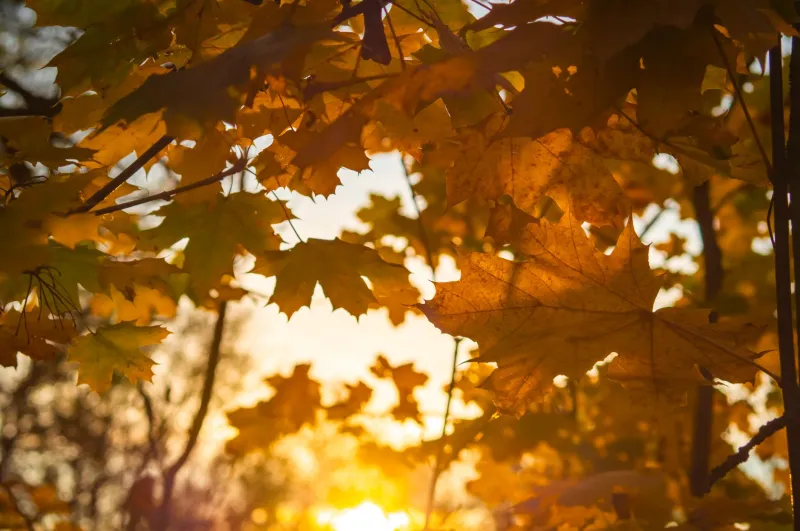
By late October, the sun's angle above the horizon has dropped considerably compared to July. Sunlight is traveling through more of the atmosphere before it reaches your eyes, which scatters shorter blue wavelengths and lets longer red, orange, and gold wavelengths dominate. Combined with the particulate haze from temperature inversions, the result is that warm, honey-colored glow that photographers and Instagram users chase every fall.
There's also the matter of duration. Days are shorter, so the golden hour that photographers love — that low-angle, warm-toned light just before sunset — lasts longer relative to the overall day. You get more of that magic light, stretched across a longer arc of the afternoon.
The Emotional Pull Is Real (And Also Science)
If Indian summer makes you feel something — a kind of bittersweet joy, a heightened awareness that the warmth is temporary — that response is well-documented. Psychologists who study seasonal affect note that unexpected positive experiences, particularly ones that contrast with expectations, register more strongly in emotional memory. You appreciate the warm Tuesday in October more than you appreciate the warm Tuesday in July, precisely because you didn't think you'd get it.
There's also something called the peak-end rule in behavioral psychology: we tend to remember experiences by their most intense moment and their ending. Indian summer is essentially autumn's peak moment — the season at its most luminous and generous — right before the curtain comes down.
That's why these days feel so charged. You're not just experiencing nice weather. You're experiencing a kind of seasonal gift, delivered at exactly the right moment to make you appreciate it fully.
Embracing the Science, Savoring the Season
Understanding why Indian summer happens doesn't make it less magical — if anything, it makes it more so. Knowing that you're standing inside a temperature inversion, wrapped in adiabatically warmed descending air, watching light scatter through a haze of suspended particles... that's kind of extraordinary, actually.
So next time that warm late-October day arrives and you find yourself peeling off your flannel and squinting into the golden afternoon light, take a second to appreciate the full picture. The atmosphere is doing something specific and beautiful just for you. Might as well dress for it.